
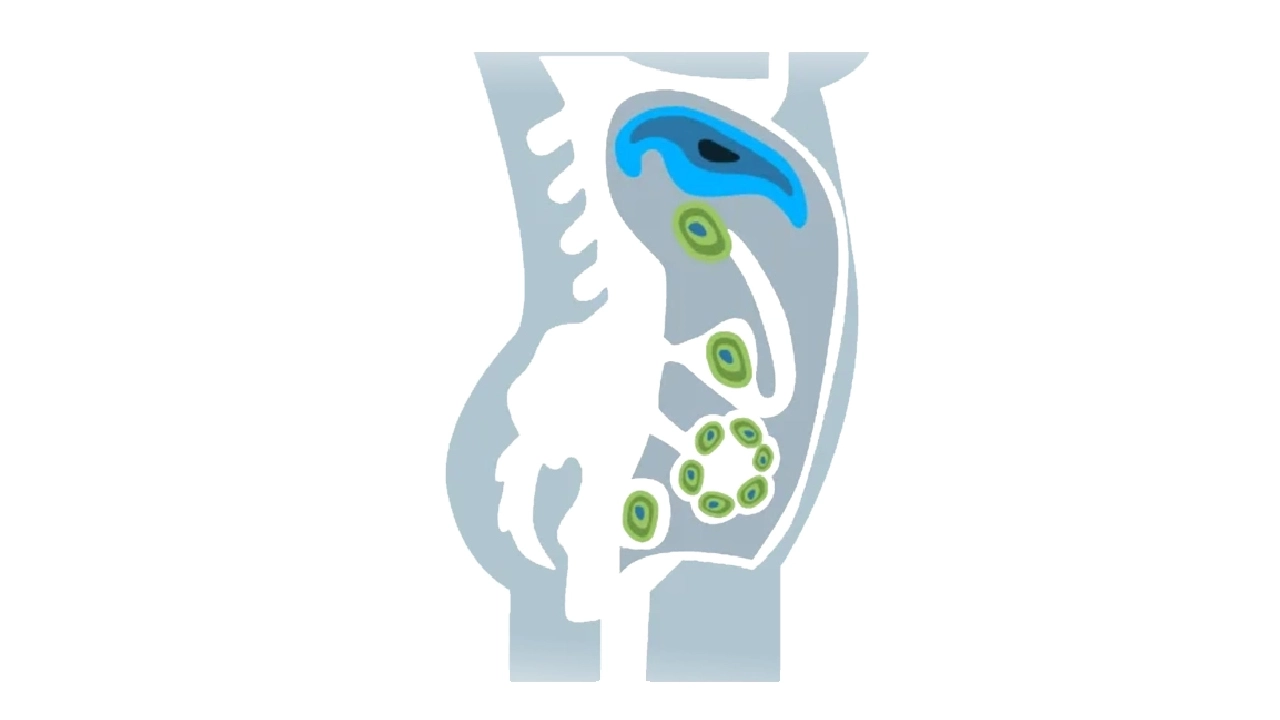
Survival in peritoneal carcinomatosis has gone from being measured in months to being measured in years. Two decades ago the median was 6-12 months and the disease was considered terminal. Today, with complete cytoreductive surgery and HIPEC in selected patients, the median is 40-60 months and cures have been documented in pseudomyxoma peritonei. The factor that weighs most is complete cytoreduction (CC-0): patients who finish surgery with no visible residual tumour reach a median of 40-60 months, against 12-20 months if disease larger than 2.5 mm remains. The specific figures vary greatly with the tumour of origin.
How much has survival in peritoneal carcinomatosis improved?
The change is large. In the 1990s, peritoneal carcinomatosis was considered a disseminated and terminal disease, with median survival of 6-12 months when treated only with systemic chemotherapy. Adding complete cytoreductive surgery combined with hyperthermic intraperitoneal chemotherapy changed that situation for the right tumours: today we speak of medians of 3-5 years in selected patients, and of long-term survival comparable to cure in low-grade pseudomyxoma peritonei. The difference does not lie in a new drug, but in a change of concept: treating peritoneal disease as a locoregional problem that can be tackled surgically, and not as a distant metastasis that is inoperable by definition. The result of that change is also reflected in perioperative mortality, which has gone from high figures in the first series to below 3% at centres with established experience.
That change of concept explains why the prognosis given to a patient can vary so much from one centre to another. A department that does not perform cytoreduction with HIPEC assesses the case with the figures of the systemic scenario, which are the ones it knows.
What is the most important prognostic factor?
Complete cytoreduction, known as CC-0: the absence of visible residual tumour at the end of the operation. Patients who achieve CC-0 have median survival of 40-60 months, against 12-20 months when residual disease larger than 2.5 mm remains. No other factor has a comparable effect, and it is also the only one the surgical team can act on directly. That is why the important clinical question is not "how much time is left" but "is it possible to achieve a complete cytoreduction in this case, and which team can achieve it". Extensive involvement of the small bowel, the liver hilum or the retroperitoneum are the findings that most often prevent it. The CC classification is also graded in several levels: CC-0 with no visible disease, CC-1 with nodules smaller than 2.5 mm, CC-2 and CC-3 with progressively larger residual disease. Only the first two levels are associated with a clear survival benefit.
One point should be added: CC-0 is not a result that depends only on the patient. It also depends on the technique, on how long an operation the team is prepared to take on and on experience with multivisceral resections. This is why centre volume consistently appears as an independent prognostic variable in published series.
What is survival by tumour of origin?
The origin of the primary tumour makes differences of years. In pseudomyxoma peritonei, 10-year survival is 50-70%, the best in the group. In peritoneal mesothelioma, medians with surgery and HIPEC range from 60 to 92 months. In colorectal origin, 5-year survival is 30-50% with surgery plus HIPEC, against less than 5% with systemic chemotherapy alone. In ovarian origin, medians are 35-55 months with optimal cytoreduction, and the tumour's chemosensitivity means a higher PCI can be tolerated. In gastric origin, the worst prognosis in the group, the median is 18-24 months in highly selected cases. These figures should also be read with the date in mind: the older series include patients treated with outdated chemotherapy regimens and less refined surgical techniques, so current figures tend to sit in the upper part of each range. In pseudomyxoma and mesothelioma, moreover, the follow-up needed to obtain 10-year data means that the published results reflect practice from more than a decade ago.
These figures come from series at specialist centres with strict selection criteria, not from general populations. Applying them to a patient who does not meet those criteria overestimates the expected result, and applying them the other way round underestimates it. You can see the approach to gastric origin in detail in the article on HIPEC in gastric carcinomatosis.
Does the PCI predict survival?
Yes, and it is the second most important variable after complete cytoreduction. The Peritoneal Cancer Index divides the abdomen into 13 regions and scores the size of the implants in each one, with a range from 0 to 39. A PCI below 10 is associated with a favourable prognosis, between 10 and 20 with an intermediate prognosis, and above 20 with clearly worse survival. The reason is largely mechanical: the higher the PCI, the less likely it is to achieve CC-0 without resections that compromise bowel function. It also has an important practical limitation: the final PCI is only known during surgery, because CT systematically underestimates implants smaller than 5 mm and involvement of the mesentery. Diagnostic laparoscopy beforehand is used precisely to reduce that margin of error before indicating a major operation. A PCI estimated from imaging and a surgical PCI can differ by several points.
The threshold is not universal. In ovarian cancer higher PCI values are accepted because the response to subsequent chemotherapy compensates for part of the tumour burden, while in gastric origin selection is much more restrictive. That is why the PCI is never interpreted on its own, but together with the type of tumour and surgical feasibility.
Does the centre where you are operated on make a difference?
Yes, and measurably so. Centres that perform more than 30 cytoreduction with HIPEC procedures a year consistently achieve better CC-0 rates, lower perioperative mortality and longer long-term survival. The volume-outcome relationship is especially marked in this surgery because these are long operations, with frequent multivisceral resections and complex perioperative management that requires a trained team in anaesthesia, intensive care and nutrition, not just an expert surgeon. Complications that are not prevented, or are poorly rescued, delay subsequent chemotherapy and erode the oncological benefit obtained in theatre. The effect shows above all in rescue capacity: not so much in having fewer complications as in detecting and resolving them in time. A centre with a trained team turns into a resolved episode what in another setting ends in a late reoperation, a prolonged stay in intensive care and a delay of months in resuming cancer treatment.
This is why choosing a centre and asking for a second opinion influence the prognosis in their own right.
What role does systemic chemotherapy play?
A complementary and necessary one, but not a substitute. Neoadjuvant chemotherapy, given before surgery, can reduce the tumour burden and make operable cases that initially were not, and it also serves as a test of the tumour's biology: progression during treatment usually argues against surgery. Adjuvant chemotherapy, given afterwards, acts on residual microscopic disease. The best published results correspond to the complete sequence, that is, perioperative chemotherapy plus optimal cytoreduction plus HIPEC, together with nutritional support and prehabilitation. In colorectal and gastric origin, the usual regimen includes chemotherapy before surgery; in low-grade pseudomyxoma, on the other hand, its role is marginal because the tumour responds poorly to cytotoxic drugs and the weight of treatment falls almost entirely on surgery. The sequence is therefore not a single one: it is defined by the tumour of origin, the response observed and the patient's condition at each point in the process.
The balance between the two stages is decided by a multidisciplinary committee. Bringing surgery forward in a tumour with aggressive biology, or delaying it too long in a controlled tumour, are the two most common sequencing errors, and both result in lost survival.
Would you like your case assessed? At Quenet Torrent Institute we treat peritoneal carcinomatosis with cytoreductive surgery and HIPEC, and we review cases that other centres have considered inoperable. Request a second opinion.