
Complete pathological response after two-stage cytoreductive surgery with HIPEC for bulky pseudomyxoma peritonei
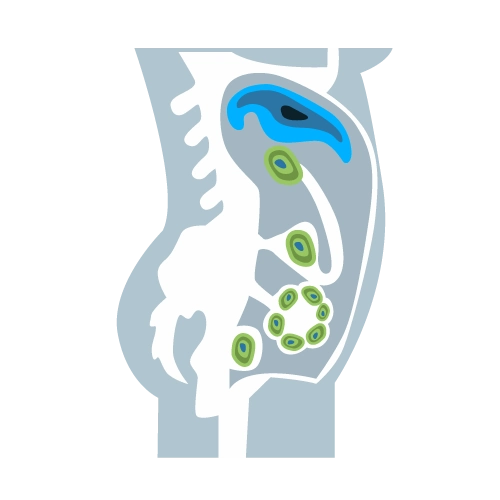
Pseudomyxoma peritonei (PMP) is a rare disease characterised by the progressive build-up of mucinous ascites and peritoneal implants. This study, published in the International Journal of Hyperthermia and signed by Dr. Olivia Sgarbura and Prof. Dr. François Quénet, presents a two-stage cytoreductive surgery strategy combined with HIPEC for patients with bulky disease.
Background to the study
The optimal treatment for pseudomyxoma peritonei includes complete cytoreductive surgery combined with hyperthermic intraperitoneal chemotherapy (HIPEC). Overall survival rates reach 55% to 63% at 10 years and 50% to 59% at 15 years when complete cytoreduction is achieved.
However, some patients have such extensive disease (a Peritoneal Cancer Index above 30 or multiple implants on the digestive tract) that achieving complete cytoreduction (CC-R0/1) may require very extensive resections, with a high risk of morbidity, especially in patients whose nutritional status is compromised.
What does this strategy propose?
The study presents a proof of concept of two-stage cytoreductive surgery with HIPEC for patients with bulky pseudomyxoma peritonei, with the aim of achieving a CC-R0/1 resection through a complete pathological response after the first stage.
Inclusion criteria
- Pseudomyxoma peritonei with a PCI above 20
- Mucinous implants of gelatinous consistency, easily detached except for a tissue base thicker than 5 mm
- Involvement of the digestive tract that would require at least 3 resections with anastomosis or 4 long continuous sutures
- Macroscopic and pathological appearance suggestive of acellular mucin or low-grade appendiceal mucinous neoplasm (LAMN)
Study methodology
First surgical stage
This included resection of the whole peritoneal surface and/or of lesions at risk of causing obstruction, but carefully excluded all other resections of the digestive tract. The thickness of the residual tumour was defined with a limit of 5 mm, based on the tissue penetration of 3-5 mm during HIPEC.
HIPEC with oxaliplatin
In both stages, HIPEC with oxaliplatin 250 mg/m² was given in 0.5% glucose solution at 2 l/m². A less aggressive dose than usual (460 mg/m²) was chosen to reduce the risk of morbidity and ensure that both stages could be completed.
Second surgical stage
Performed after an interval of 3-4 months, it included a complete exploration, resection of macroscopic disease and resection or biopsy of the lesions described previously, even when they were not always macroscopically visible.
Main results
Patients completed both stages
Mortality
Complete pathological response
Months of median follow-up
Main finding
No macroscopically visible residual disease was found at the second stage of cytoreductive surgery. All biopsies and specimens were free of residual disease on pathological examination and showed signs of fibrosis, suggesting a complete histological response to HIPEC.
Organ preservation
Only 1 patient required bowel resection during the first stage and 2 patients during the second stage. Preserving more organs helped to reduce morbidity.
Morbidity
- Only 1 Clavien-Dindo grade 3 event in each stage
- Mortality: 0%
- Median hospital stay: 16.5 days (first stage), 11.5 days (second stage)
Survival and follow-up
All patients are alive and free of recurrence after a median follow-up of 31.5 months (range 17-65 months).
Clinical implications
Redefining CC-R2
This study opens the door to a future refinement of the CC-R2 category and of the real need for the second stage when a complete pathological response is achieved. Traditionally:
- CC-R0: No macroscopic residual disease
- CC-R1: Maximum diameter of any residual nodule ≤2.5 mm
- CC-R2: Nodules between 2.5 mm and 2.5 cm
- CC-R3: Nodules larger than 2.5 cm
Advantages of the two-stage strategy
1. Access to curative treatment
Patients with bulky disease and compromised general condition can reach the prognosis of patients treated with curative intent.
2. Reduced morbidity
It avoids ultra-extensive surgery in patients whose nutritional status is compromised.
3. Visceral preservation
Greater organ preservation compared with complete cytoreduction in a single stage.
4. Complete response to HIPEC
It suggests that hyperthermic intraperitoneal chemotherapy is effective in low-grade disease.
Choice of oxaliplatin
Oxaliplatin was chosen over other cytotoxic drugs on the basis of:
- Ex vivo studies that showed almost identical IC50 values for cisplatin and oxaliplatin in PMP subgroups
- The possibility of giving a higher intraperitoneal dose of oxaliplatin compared with cisplatin
- A good safety profile at a dose of 250 mg/m²
Future perspectives
This study proposes a change in the treatment of bulky pseudomyxoma peritonei. The results suggest that:
- The two-stage strategy is feasible and safe in selected patients
- A complete pathological response may remove the need for extensive resections in the second stage
- Prospective studies are needed to confirm these preliminary results
- Other de-escalation strategies may be developed on the basis of these findings
Original publication
Sgarbura O, Al Hosni M, Petruzziello A, et al. Complete pathologic response after two-stage cytoreductive surgery with HIPEC for bulky pseudomyxoma peritonei: proof of concept. International Journal of Hyperthermia. 2020;37(1):585-591.
Conclusion
In this series of 8 patients with bulky low-grade pseudomyxoma peritonei, two-stage cytoreductive surgery with HIPEC achieved a complete pathological response with low morbidity while preserving organs. These are preliminary results that need to be confirmed in prospective studies.
Do you need a second opinion on pseudomyxoma peritonei?
Dr. François Quénet, author of this study, treats pseudomyxoma peritonei with cytoreductive surgery and HIPEC.
Request a consultation