
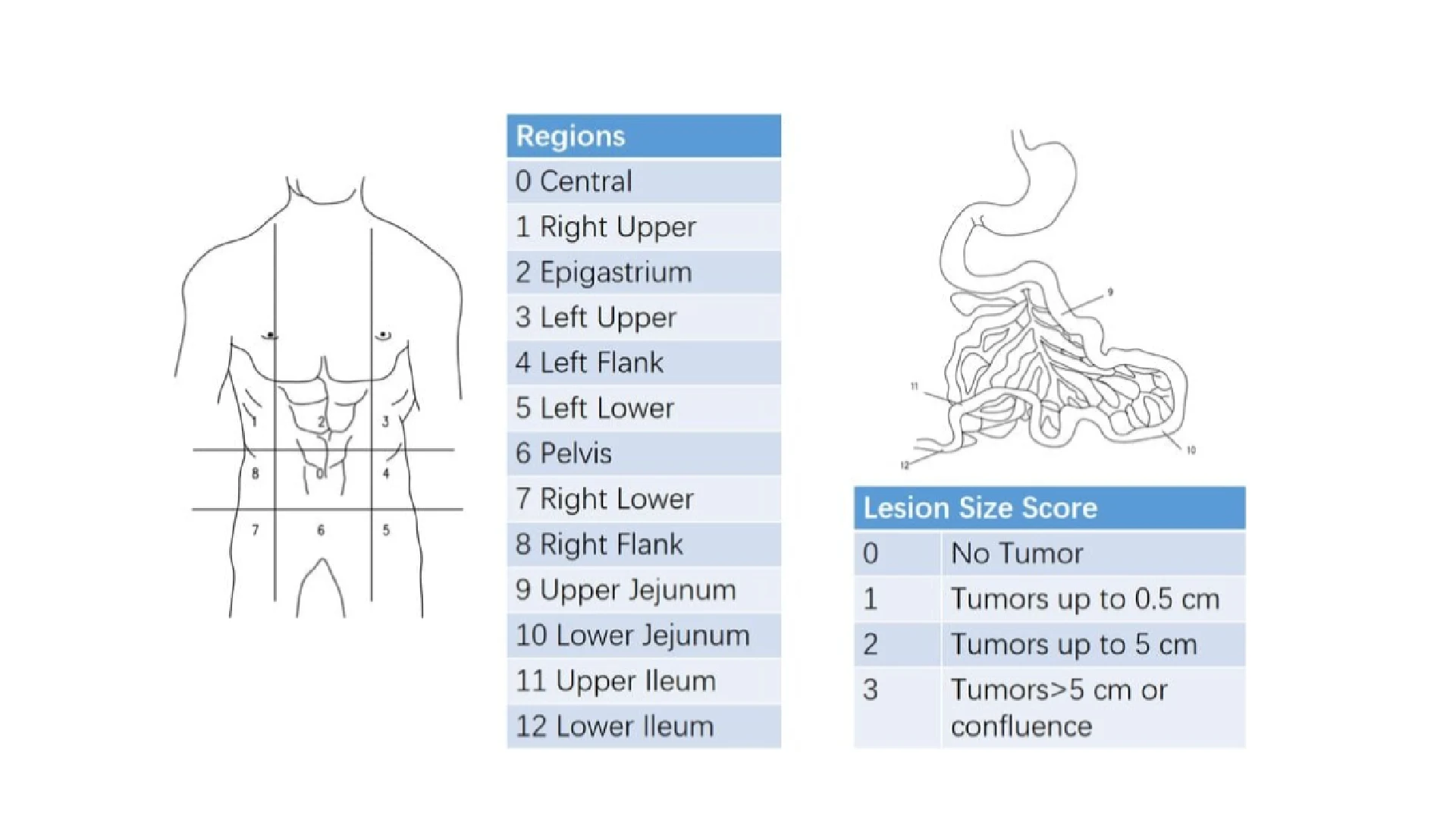
The Peritoneal Cancer Index, known as the PCI, is a tool used in surgical oncology to assess the extent of disease inside the abdominal cavity.
It is used in the assessment of patients with peritoneal carcinomatosis, because it allows the tumor burden to be estimated and guides treatment decisions, especially when cytoreductive surgery combined with HIPEC is being considered.
What the PCI measures
The PCI quantifies the distribution and size of tumor implants on the peritoneum. To do this, the abdomen is divided into different regions, and the presence of tumor is assessed in each one.
Each area is given a score based on the size of the lesions seen. The sum of these scores gives a total value that reflects the overall extent of the disease.
The higher the PCI, the greater the tumor burden.
Could this case be eligible for surgery?
Send the case and our surgical team will review whether it can be assessed for surgery. First contact within 24-48h.
How it is calculated
The PCI is usually calculated during surgery or, in selected cases, from imaging tests. The abdomen is divided into 13 regions, including central areas and segments of the small bowel.
Each region is given a score according to tumor size:
• No visible lesions: score 0
• Small nodules (less than 0.5 cm): score 1
• Intermediate-sized lesions (between 0.5 and 5 cm): score 2
• Large or confluent tumor implants (larger than 5 cm): score 3
The total can reach high values, which indicates extensive involvement of the peritoneum.
What it is used for in clinical practice
The PCI is used above all to determine whether a patient can benefit from certain treatments, especially cytoreductive surgery.
In general, lower values are associated with better surgical outcomes, while a high PCI may indicate that the disease is too extensive for an effective resection.
The index also helps standardize assessment between different medical teams and makes treatment planning easier.
Relationship with cytoreductive surgery
One of the main uses of the PCI is to assess whether surgery is feasible. In some types of cancer, the possibility of removing most of the tumor depends largely on the extent of the disease.
Although there is no single cut-off that applies to every case, the PCI is one of the factors taken into account when selecting patients for this type of operation, together with techniques such as HIPEC.
Limitations of the index
Despite its usefulness, the PCI is not the only factor that determines treatment. Other aspects, such as the type of tumor, the patient's general condition or the response to previous treatments, also play a decisive role.
For this reason, it must always be interpreted within a complete clinical assessment.
Importance of specialized assessment
Calculating and interpreting the PCI requires experience with peritoneal carcinomatosis. Applied correctly, it helps guide treatment decisions and offer a more personalized approach.
That is why the assessment should be made by specialized teams, who interpret the index together with the rest of the patient's data.
The PCI in the different types of peritoneal carcinomatosis
How the PCI is interpreted depends on the primary tumor. Each condition has different thresholds and surgical strategies:
• Carcinomatosis of colorectal origin: low-to-moderate PCI as a selection criterion for surgery.
• Carcinomatosis of ovarian origin: higher PCI values are tolerated because of its high chemosensitivity.
• Carcinomatosis of gastric origin: very strict selection, with low PCI and complete cytoreduction.
• Pseudomyxoma peritonei (appendiceal origin): high PCI values are accepted given its slow progression and its response to treatment.
• Peritoneal mesothelioma: individual decision in a multidisciplinary committee.
Related procedures
After the PCI assessment, the surgical and oncological options for eligible cases include:
• Cytoreductive surgery (CRS): the core treatment to remove visible disease.
• HIPEC (hyperthermic intraperitoneal chemotherapy): heated chemotherapy in the abdominal cavity after cytoreduction.
• PIPAC: for patients who are not candidates for radical surgery.
• Robotic surgery: for laparoscopic PCI assessment and selected cases.
Have you been diagnosed with peritoneal carcinomatosis? At Quenet Torrent Institute we have a unit dedicated to cytoreductive surgery and HIPEC. We can review your case and calculate your PCI individually. Request an assessment.