
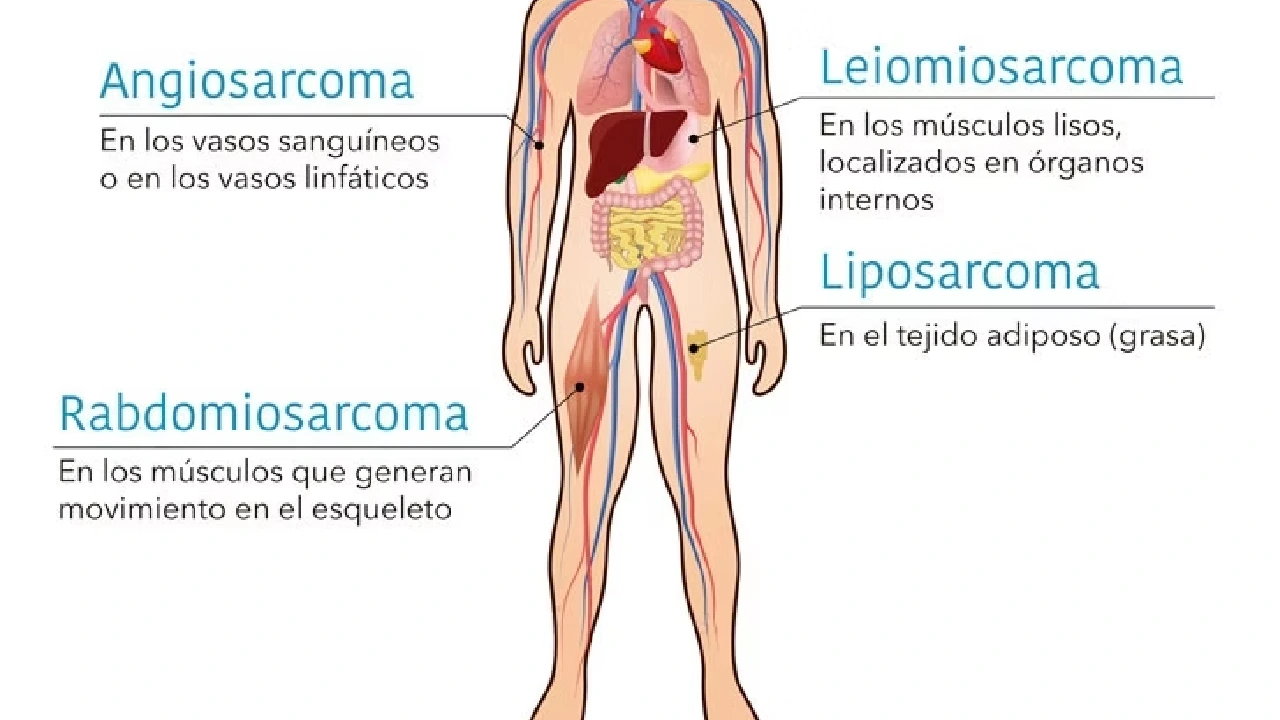
What is a sarcoma?
Sarcomas are rare malignant tumours that arise in connective tissue (bone, cartilage, fat, muscle, blood vessels, fibrous tissue). They account for <1% of all cancers in adults and ~15% in children.
Main classification
Soft tissue sarcomas (80%): Muscle, fat, vessels, connective tissue
Bone sarcomas (20%): Osteosarcoma, chondrosarcoma, Ewing sarcoma
Main types of soft tissue sarcoma
Liposarcoma: Fatty tissue. Most common in adults (20%). Subtypes: well-differentiated, myxoid, pleomorphic, dedifferentiated
Leiomyosarcoma: Smooth muscle (15%). More aggressive, higher risk of metastasis
GIST: Gastrointestinal stroma. Sensitive to imatinib
Undifferentiated pleomorphic sarcoma: Formerly called "malignant fibrous histiocytoma". High grade
Fibrosarcoma: Fibrous tissue
Rhabdomyosarcoma: Skeletal muscle. More common in children
Angiosarcoma: Blood vessels. Very aggressive
Synovial sarcoma: Synovial tissue of the joints
Myxofibrosarcoma: Myxoid tissue
Histological grade
Low grade (G1): Slow growth, lower risk of metastasis, better prognosis
Intermediate grade (G2): Intermediate behaviour
High grade (G3): Aggressive, high risk of metastasis, worse prognosis
Location
Limbs (50%): Thigh, shoulder, arm
Retroperitoneum/abdomen (30%): See retroperitoneal sarcomas
Trunk/chest wall (15%)
Head/neck (5%)
Treatment
See specialist treatment of sarcomas and prognosis.
Why the type matters less than who operates
Knowing the subtype and grade helps to understand the diagnosis, but in a sarcoma there is one factor that weighs more than any classification: the first operation. It is the one that most influences the prognosis.
A sarcoma removed with insufficient margins, or opened during the operation, changes the situation completely: the risk of local recurrence rises and much more aggressive reoperations become necessary. By contrast, an en bloc resection with adequate margins at the first attempt gives the best chance of controlling the disease.
That is why European guidelines recommend that every sarcoma be treated at a reference centre before the first operation, not after something has gone wrong.
Retroperitoneal and abdominal sarcomas: the most demanding scenario
30% of soft tissue sarcomas are located in the retroperitoneum or abdomen, and they are the most technically difficult. They grow without symptoms until they are very large and end up surrounded by critical structures: kidney, major vessels, pancreas, colon.
Removing them correctly often requires multivisceral resection and, sometimes, vascular reconstruction. This is surgery that cannot be improvised: it requires a team with oncovascular capability and sufficient volume in abdominal and retroperitoneal sarcomas.
If the sarcoma has already been operated on and has recurred, salvage surgery is still a real option in selected cases, although there is less room for manoeuvre.
Have you been diagnosed with a sarcoma, or is one suspected? A second opinion adds most before the first operation. We review your tests and tell you whether the proposed resection is the right one for your case. Request an assessment.