
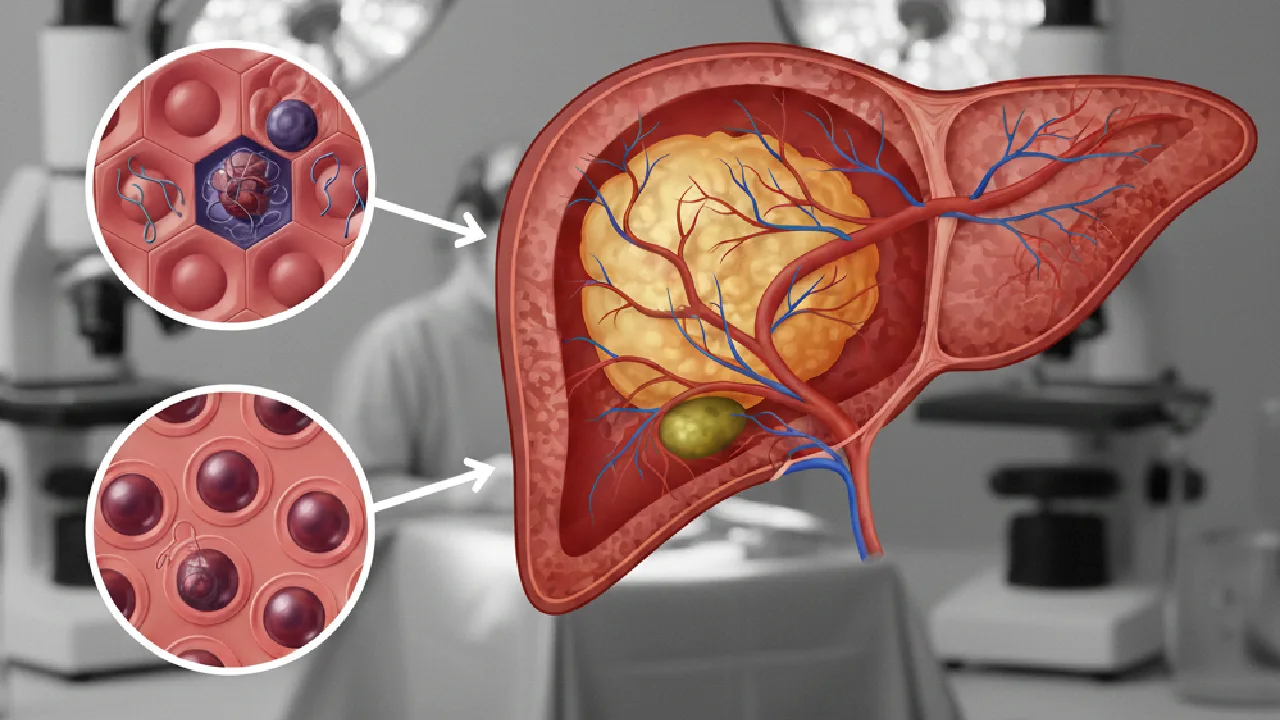
What are liver metastases?
Liver metastases are secondary tumours in the liver. They form when cancer cells from other organs spread and settle in liver tissue. They are much more common than primary liver cancer.
The liver is one of the organs where metastases appear most often, because of its abundant blood flow and its role as a filter for blood coming from the digestive system.
Causes and most common primary tumours
Liver metastases can originate from many primary cancers:
• Colorectal cancer: The most common cause. Up to 50% of patients will develop liver metastases
• Pancreatic cancer: High tendency to metastasise to the liver
• Gastric cancer: Liver involvement is common in advanced stages
• Breast cancer: Can produce liver metastases years after the initial diagnosis
• Melanoma: High tendency to spread to the liver
• Neuroendocrine tumours: Often produce liver metastases
Symptoms and diagnosis
Symptoms: In early stages they may cause no symptoms. When symptoms appear they include pain in the right upper abdomen, weight loss, jaundice, ascites, fatigue and general malaise.
Diagnosis: Contrast-enhanced liver CT or MRI (gold standard), PET-CT to assess extrahepatic disease, tumour markers (CEA in colorectal cancer), biopsy in selected cases.
Available treatments
Surgical resection: The only potentially curative treatment. At Quenet Torrent Institute we perform complex hepatectomies using minimally invasive and robotic techniques. 5-year survival of 30-50% in selected cases.
Radiofrequency/microwave ablation: For small (<3 cm) unresectable tumours. It can be combined with surgery.
Chemoembolisation (TACE): Chemotherapy delivered directly into the hepatic arteries feeding the tumour.
Radioembolisation (SIRT): Radioactive microspheres that selectively irradiate the metastases.
Systemic chemotherapy: Depends on the primary tumour. In colorectal metastases: FOLFOX, FOLFIRI, combined with bevacizumab or cetuximab.
The main question: are they operable?
Of everything above, only one thing really changes the prognosis: whether the metastases can be removed. Resection is the only potentially curative treatment, and yet many patients are told they are inoperable without having been seen by a specialist liver surgery team.
Resectability does not depend on the number of lesions, as was believed years ago. Today the criteria are different:
• Enough liver must remain after resection (usually 25-30% of functional volume, more if the liver has been damaged by chemotherapy).
• Vascular and biliary flow to the remaining liver must be preserved.
• Extrahepatic disease must be controlled or also resectable.
A patient with six bilobar metastases may be operable, and one with a single badly placed lesion may not be. That is why the assessment has to be made by someone who operates on livers, not only by someone who interprets the imaging.
What to do when you have been told "inoperable"
"Inoperable today" does not always mean inoperable. There are specific strategies to convert an unresectable case into a resectable one:
Conversion chemotherapy: shrinking the lesions until they can be removed. Between 15 and 30% of initially unresectable patients reach surgery this way.
Portal embolisation and hypertrophy: the part of the liver that will remain is made to grow before surgery, so that enough functional volume is left.
Two-stage hepatectomy: the resection is split into two operations several weeks apart, allowing the liver to regenerate between them.
Hepatic arterial infusion chemotherapy (HAI): delivered directly into the hepatic artery, with response rates much higher than the systemic route in colorectal metastases.
Combination with interventional radiology: resecting what can be resected and ablating the rest in the same procedure, using combined techniques.
Have you been told your liver metastases cannot be operated on? It is the most common reason patients come to us, and in some cases there is a surgical route that had not been considered. We review your tests and give you a clear answer about resectability. Request an assessment.