
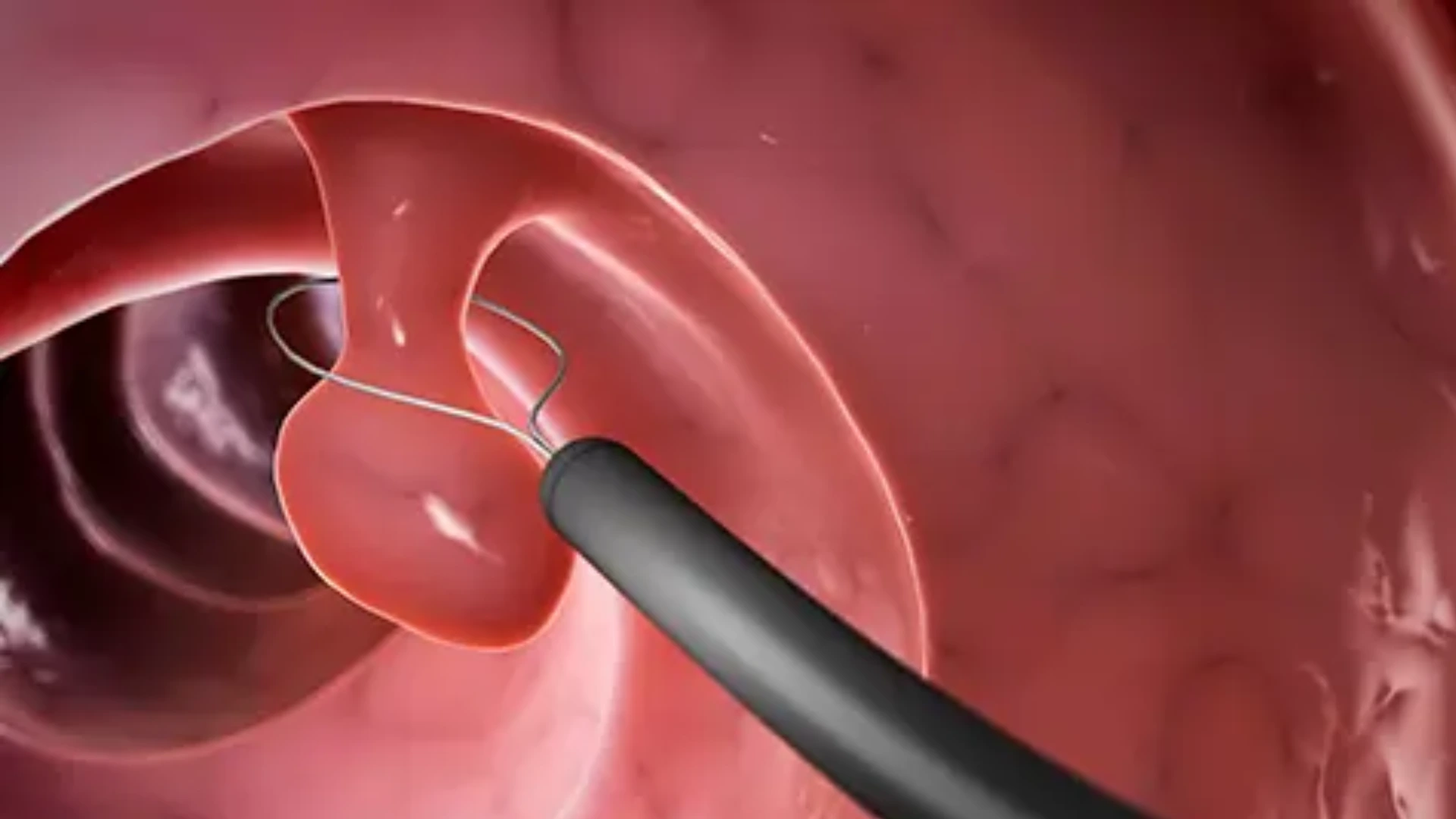
Colon polyps are growths in the inner lining of the large bowel. Most are benign and cause no symptoms, but some types, especially adenomas and serrated polyps, can turn into cancer over the years. That is why they are removed when found, almost always during the same colonoscopy, and the lab result decides whether another colonoscopy is needed and when.
What is a colon polyp?
A polyp is a bump in the mucosa, the layer that lines the inside of the colon and rectum. It can be mushroom-shaped, with a stalk, or flat. Polyps become more common with age and it is usual to have more than one.
They matter because most colorectal cancers start as a polyp. That change usually takes years, and if the polyp is removed first the cancer never forms. This is the basis of colorectal cancer screening.
What types of polyps are there and which can become cancer?
The ones that can turn into cancer are mainly adenomas and serrated polyps. The exact type is confirmed by analyzing the polyp once it has been removed.
- Adenomas. The most common of the polyps that can become malignant. The lab classifies them as tubular or villous, and villous adenomas are more likely to turn into cancer.
- Serrated polyps. Less common. Some, especially large ones or those with dysplasia, can also progress to cancer, and they are sometimes flat and harder to see.
- Hyperplastic polyps. They very rarely become cancer, especially small ones at the end of the colon.
- Inflammatory polyps, which appear in people with ulcerative colitis or Crohn's disease.
Size matters too: a polyp of one centimeter or more carries more risk than a small one. The pathology report also states whether there is dysplasia, meaning cells with changes, and whether it is low or high grade.
Why do polyps form in the colon?
The risk rises with age and with a family history of polyps or colorectal cancer. Habits play a part as well: a diet high in fat and red or processed meat and low in fiber, a sedentary lifestyle, excess weight, smoking and alcohol.
In a minority of people polyps are caused by a hereditary syndrome. In familial adenomatous polyposis hundreds or thousands of adenomas appear from a young age. Lynch syndrome does not cause as many polyps, but it makes them progress faster. When there are many polyps, polyps at a young age or several affected relatives, an assessment at a high-risk clinic is recommended.
Do polyps cause symptoms?
They almost never cause symptoms, which is why they are found during screening colonoscopies or ones done for another reason. When they do, the usual signs are blood in the stool, a change in bowel habits or tiredness from anemia if they bleed slowly over months.
How are polyps found?
The main test is colonoscopy, which shows the whole colon and allows polyps to be removed on the spot. The fecal occult blood test used in screening does not see polyps, but it picks up traces of blood that some of them produce, and a positive result leads to a colonoscopy. When a colonoscopy cannot be completed, CT colonography (virtual colonoscopy) is used; it detects polyps but cannot remove them.
How are polyps removed?
Most are removed during colonoscopy, a procedure called polypectomy. A snare or forceps cuts the polyp at its base and it is retrieved for analysis. It does not hurt, because the lining of the colon cannot feel cutting and the test is done under sedation.
Large or flat polyps may need more advanced endoscopic techniques, sometimes removing them in several pieces, in which case the colonoscopy is repeated a few months later to check nothing is left.
Surgery is considered when a polyp cannot be removed safely by endoscopy or when the lab shows a cancer with features that require removing that section of bowel and its lymph nodes as well. This is a colon resection. We perform it robotically whenever possible, and the usual hospital stay is 2 to 5 days. We explain it in colon cancer.
How often do I need a check-up after a polyp is removed?
It depends on the lab result. With a few small adenomas you return to routine screening, and with large or higher-risk polyps the colonoscopy is repeated at 3 years. The result takes a few days or weeks. Depending on what it shows, the European Society of Gastrointestinal Endoscopy guideline (ESGE, 2020) recommends:
- Returning to routine screening, with no surveillance colonoscopies, if one to four adenomas under one centimeter with low-grade dysplasia were removed, or serrated polyps under one centimeter without dysplasia.
- A colonoscopy at 3 years if there was at least one adenoma of one centimeter or more, high-grade dysplasia, five or more adenomas, or a serrated polyp of one centimeter or more or with dysplasia.
- A colonoscopy at 3 to 6 months if a polyp of two centimeters or more was removed in pieces.
These are general criteria. Family history, the quality of the colonoscopy or a hereditary syndrome change the plan, and your specialist decides the interval.
Frequently asked questions
Are colon polyps cancer?
Most are not. Some types, especially adenomas and serrated polyps, can turn into cancer over the years, which is why they are removed when found.
Does removing a polyp hurt?
No. It is removed during the colonoscopy, which is usually done under sedation, and the lining of the colon cannot feel cutting.
What symptoms do polyps cause?
They almost never cause symptoms. When they do, there may be blood in the stool, changes in bowel habits or tiredness from anemia.
I had a polyp removed. When is my next colonoscopy?
It depends on the lab result. With a few small low-grade adenomas you return to routine screening; with polyps of one centimeter or more, high-grade dysplasia or five or more adenomas, the European guideline recommends a colonoscopy at 3 years. Your specialist adjusts this to your case.
Can polyps come back?
Yes. People who have had adenomas can develop new ones, which is what surveillance colonoscopies are for when they are indicated.
When does a polyp need surgery?
Rarely: when it cannot be removed safely by endoscopy or when the lab shows a cancer that requires removing that section of bowel and its lymph nodes.
References
- Hassan C, Antonelli G, Dumonceau JM, et al. Post-polypectomy colonoscopy surveillance: European Society of Gastrointestinal Endoscopy (ESGE) Guideline. Update 2020. Endoscopy. 2020;52:687-700. doi:10.1055/a-1185-3109.
- MedlinePlus, U.S. National Library of Medicine. Colorectal polyps.
This information is for general guidance and does not replace an assessment by your doctor.