
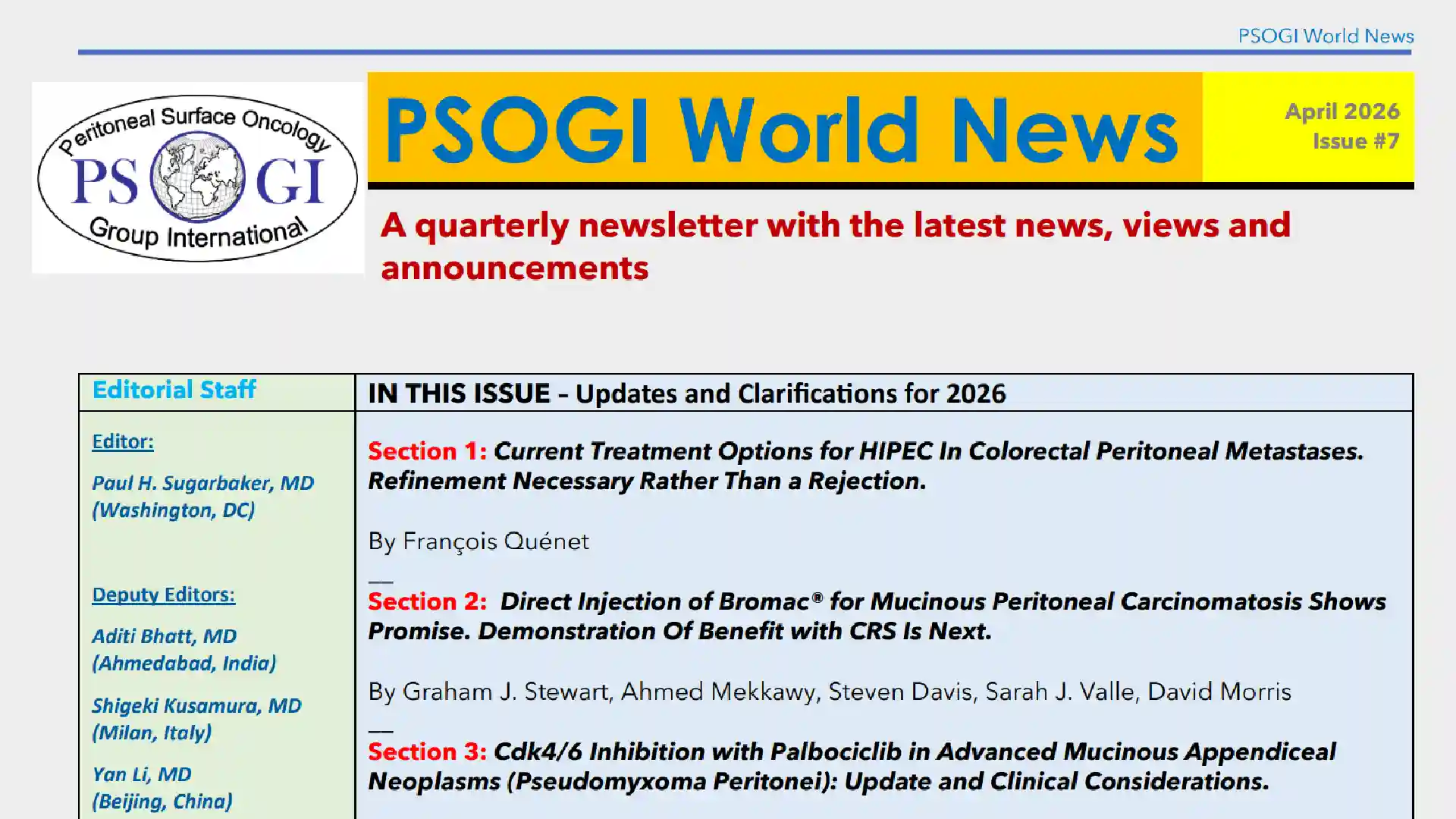
What the bulletin is about
PSOGI World News is the official scientific publication of the Peritoneal Surface Oncology Group International, the international medical society dedicated to the treatment of peritoneal diseases. Each issue brings together opinion articles and expert reviews on cytoreductive surgery, HIPEC, PIPAC and new intraperitoneal therapies.
Main topics of the April issue
Colorectal cancer with peritoneal metastases
Several articles discuss the results of the PRODIGE 7 trial, which did not show a clear benefit of HIPEC with oxaliplatin. However, the authors point out that other combinations, especially with mitomycin C, still make sense in selected patient groups with peritoneal carcinomatosis of colorectal origin. The reading is not "HIPEC does not work", but "we need to refine which drug to use it with".
Peritoneal pseudomyxoma
The issue analyzes the role of HIPEC both in initial surgery and in reoperations of peritoneal pseudomyxoma. The conclusion is that HIPEC appears more justified in the initial surgery than in reoperation, where its contribution is less evident.
Mucinous appendiceal tumors
Emerging therapies appear, such as palbociclib, intraperitoneal paclitaxel and BromAc, with favorable first results. The evidence is still limited.
Neoadjuvant chemotherapy
Several authors insist that chemotherapy before surgery does not always bring a benefit and that the decision must be individualized case by case, taking into account the tumor type, the extent of disease and the patient's condition. Deciding requires an individualized prognostic assessment.
Organoids and precision medicine
The bulletin suggests that tumor-derived organoids (mini-replicas of the patient's tumor grown in the laboratory) could help predict which treatment will work best in each person. If confirmed, this would allow intraperitoneal chemotherapy to be tailored to each patient.
Advanced ovarian and tubo-ovarian cancer
The issue reviews the current evidence and ongoing clinical trials on HIPEC after surgery in advanced ovarian cancer, an area in which HIPEC has increasingly solid data in selected patients.
"HIPEC still has a role, but we must refine when, how and with which drugs to use it."
Central idea of the April 2026 issue
Why it matters to us
At Quenet Torrent Institute we follow the PSOGI scientific debates because they affect our clinical practice. We tailor the indication of HIPEC to tumor type, patient status and expected surgical outcome, and we review every case in a multidisciplinary setting. Good patient selection and a complete cytoreductive surgery are, at present, the two factors with the greatest influence on prognosis.
If you want to go deeper into the clinical context, you can read our articles on prognosis and life expectancy in peritoneal carcinomatosis and the Peritoneal Cancer Index (PCI).
Original source: full bulletin on the PSOGI society website.
Read on PSOGI World News