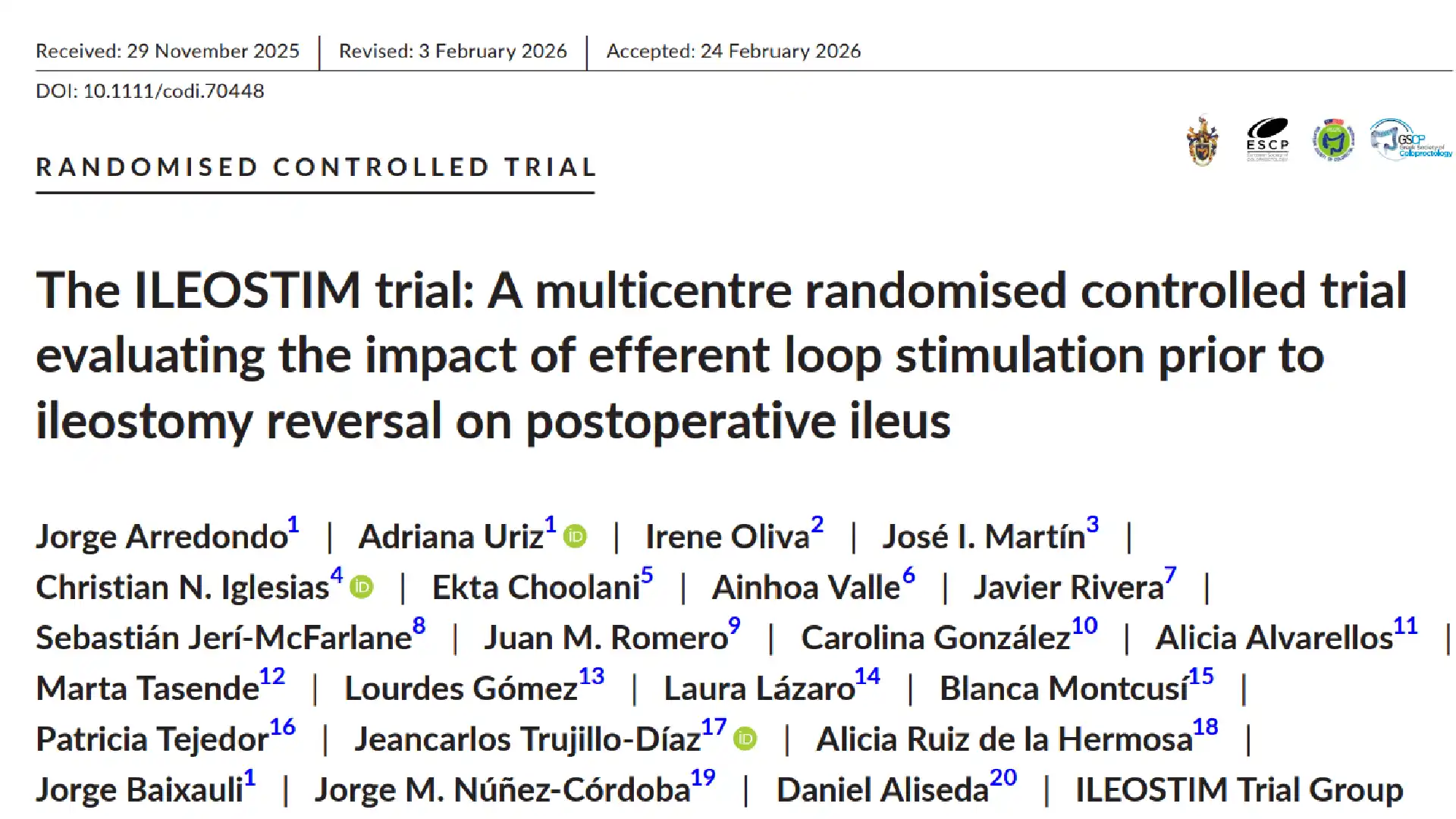
ILEOSTIM trial: efferent loop stimulation before ileostomy reversal
Multicentre randomised controlled trial across 18 Spanish hospitals evaluating whether preoperative efferent loop stimulation can reduce postoperative ileus after ileostomy reversal surgery
What does the ILEOSTIM trial assess?
The ILEOSTIM trial is a multicentre randomised controlled trial evaluating whether preoperative efferent loop stimulation before ileostomy closure can reduce postoperative ileus following stoma reversal. The study, in which Dr. Patricia Tejedor participates, was conducted across 18 hospitals in Spain and is published in Colorectal Disease (2026).
Postoperative ileus is one of the most frequent complications after colorectal surgery and prolongs hospital stay, delays the reintroduction of normal diet, and increases healthcare costs. Identifying simple, reproducible and safe strategies to prevent it has direct impact on patient recovery.
Trial design and methodology
175 patients with a defunctioning ileostomy after rectal cancer surgery were recruited between 2021 and 2023. Participants were randomly assigned to:
- Intervention group · daily efferent loop stimulation for 2 weeks before reversal surgery.
- Control group · direct surgery without preoperative stimulation.
The stimulation technique consisted of daily irrigations with 500 mL of saline solution and a nutritional thickener, performed partly by the patient at home and partly under nursing supervision. The procedure was designed to be reproducible across any centre and using accessible materials.
Primary outcome · postoperative ileus
The primary endpoint was the incidence of postoperative ileus following ileostomy closure. The stimulation group showed fewer cases of ileus, although the difference did not reach statistical significance:
- Intervention group (stimulation): postoperative ileus in 7.6% of patients.
- Control group (no stimulation): postoperative ileus in 16.4% of patients.
- p = 0.088 for the primary comparison.
In the adjusted analysis for relevant covariates, stimulation maintained a favourable trend but again did not reach statistical significance. However, the absolute reduction (≈ 9 percentage points) is clinically relevant and justifies continued investigation of the strategy.
Secondary outcomes
The trial also assessed additional clinical variables associated with recovery after reversal:
- No significant differences in hospital stay between groups.
- No differences in the appearance of low anterior resection syndrome (LARS) at discharge.
- No improvement in time to normal diet tolerance or to first passage of flatus.
- A difference was seen in time to first bowel movement, which was later in the stimulation group · a finding discussed by the authors.
Safety and clinical interpretation
The technique was considered feasible, safe and reproducible. No relevant complications directly attributable to efferent loop stimulation were recorded. The authors conclude that this is a promising strategy to reduce postoperative ileus, but further studies are needed to confirm the observed benefit, since the primary endpoint did not reach statistical significance in this trial.
"Preoperative stimulation appears useful and safe; the clinical difference of 7.6% versus 16.4% in postoperative ileus supports further investigation of this simple, reproducible and low-cost strategy, even though this trial does not yet demonstrate definitive statistical superiority."
— Adapted conclusion from the study, Colorectal Disease · 2026
Key idea
Preoperative efferent loop stimulation before ileostomy reversal appears useful and safe, but this trial does not definitively demonstrate that it reduces postoperative ileus · the observed effect is clinically relevant and justifies further trials.
Why this multicentre collaboration matters
ILEOSTIM is an example of the strength of collaborative colorectal research in Spain, with 18 coordinated hospitals, surgeons, residents, nurses and researchers working together on a simple but clinically relevant question. National collaborations such as this demonstrate how teamwork generates high-quality evidence with direct impact on patient outcomes.
Dr. Patricia Tejedor · colorectal and robotic surgeon
Dr. Patricia Tejedor, member of the Quenet Torrent Institute team, contributes to ILEOSTIM as part of a group of leading investigators in oncological colorectal surgery. Her work combines robotic colorectal surgery, patient-reported outcome measures (PROMs) and perioperative optimisation to reduce complications after oncological surgery · a continuum with her recent participation in the 2nd Robotic Surgery On Air Global Event.
View Dr. Patricia Tejedor's profile
Bibliographic reference
The ILEOSTIM trial: A multicentre randomised controlled trial evaluating the impact of efferent loop stimulation prior to ileostomy reversal on postoperative ileus. Colorectal Disease, 2026.