
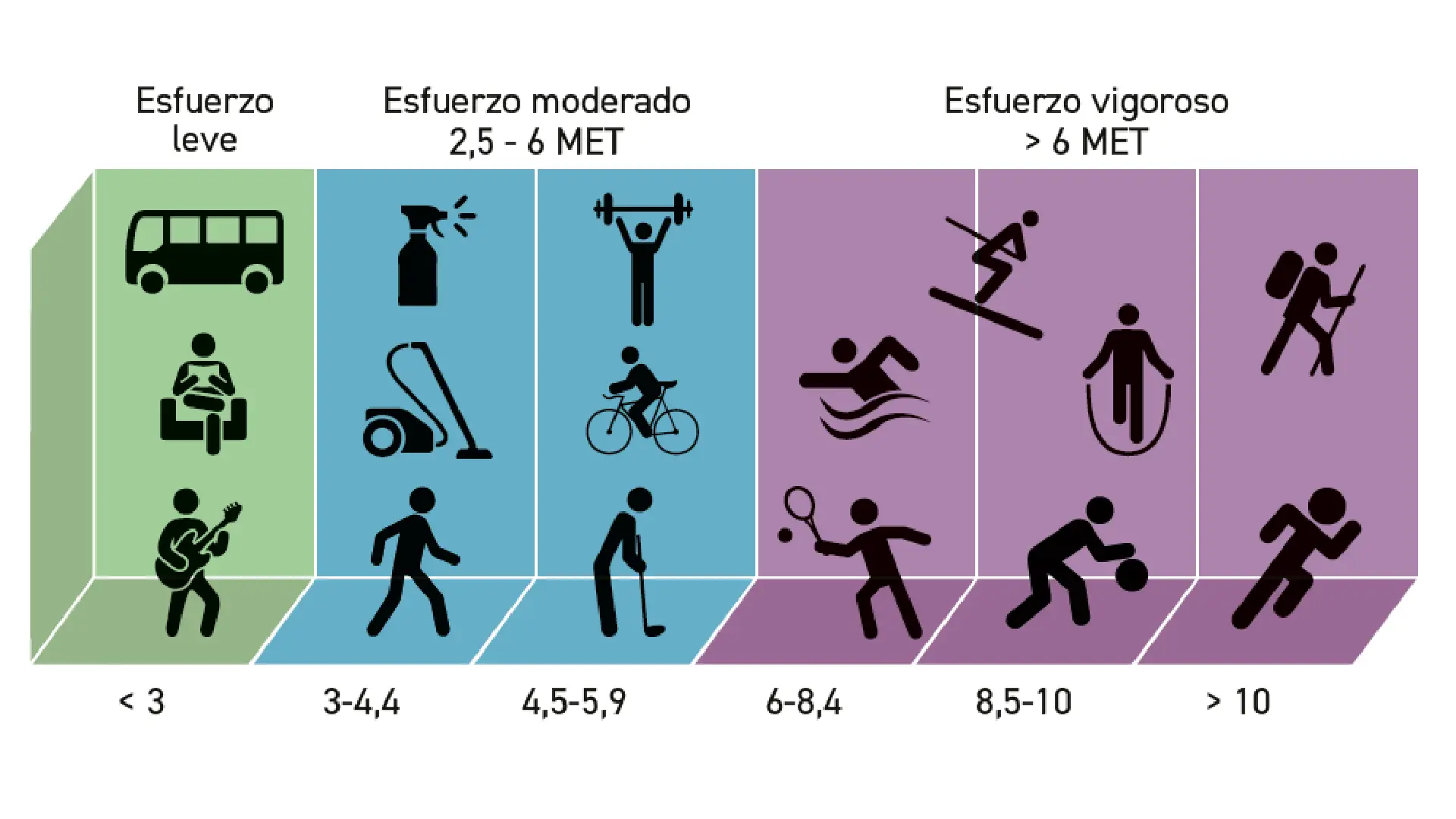
When someone is scheduled for major oncological surgery, almost the same question always comes up: "what can I do to arrive in better shape for the operation?". The answer has a name: prehabilitation. And to measure your starting point and set goals, clinicians use a simple unit, the MET. In this guide you will find a MET table with everyday activities, what the 4-MET threshold means and a calculator to estimate your functional reserve.
What a MET is (in plain words)
A MET (Metabolic Equivalent of Task) is the energy your body uses at rest, sitting quietly. It equals an oxygen uptake of about 3.5 millilitres per kilo of body weight per minute.
Every activity is then measured as a multiple of that resting state:
• 1 MET = sitting at rest.
• 4 METs = climbing a flight of stairs without stopping.
• 8 METs = running or a demanding sport.
In other words: the more METs you can sustain, the greater your functional reserve, that is, the ability of your heart, lungs and muscles to cope with the stress of surgery.
MET table: everyday activities and their intensity
This is the reference that helps most. Find what you do without difficulty in daily life and check how many METs it equals. Values are population averages (Ainsworth Compendium of Physical Activities).
| Everyday activity | METs | Intensity |
|---|---|---|
| Sitting at rest | 1.0 | Rest |
| Self-care (eating, dressing, washing) | 2.0 | Light |
| Walking slowly around the house | 2.0 | Light |
| Light housework (dusting, washing dishes) | 2.7 | Light |
| Walking one or two blocks on level ground | 2.8 | Light |
| Brisk walking (4.8 km/h) | 3.5 | Moderate |
| Moderate housework (vacuuming, sweeping, carrying groceries) | 3.5 | Moderate |
| Yardwork (raking, mowing the lawn) | 4.0 | Moderate |
| Walking fast (5.6 km/h) | 4.3 | Moderate |
| Climbing a flight of stairs or a hill | 4.0 to 8.0 | Moderate to vigorous |
| Dancing, moderate recreation (golf, bowling, doubles tennis) | 4.5 to 6.0 | Moderate |
| Cycling at an easy pace | 6.0 | Vigorous |
| Swimming, rowing | 6.0 | Vigorous |
| Jogging | 7.0 | Vigorous |
| Heavy housework (scrubbing floors, moving furniture) | 8.0 | Vigorous |
| Running, strenuous sport | 8.0 to 11.5 | Vigorous |
Source: Compendium of Physical Activities (Ainsworth BE et al.). Population-average values, for orientation.
The 4-MET threshold: the reference figure before surgery
If there is one number worth remembering, it is 4 METs. It is the threshold surgical teams use as a safety reference.
A very practical way to know where you stand: can you climb two flights of stairs without stopping to rest? If yes, you most likely clear 4 METs. If you have to stop, it is worth assessing with your medical team.
• Above 4 METs: good functional reserve, lower perioperative risk on this marker.
• Below 4 METs: reduced capacity. This is precisely the patient profile that benefits most from prehabilitation before surgery.
What prehabilitation is and why it matters
Prehabilitation means preparing the body in the weeks before the operation, on three pillars: physical exercise, nutrition and medical optimisation (controlling anaemia, blood sugar, blood pressure, quitting smoking).
In major surgery, improving functional reserve before entering the operating room is associated with fewer complications, shorter stays and faster recovery. The ideal window is 3 to 6 weeks, enough time to achieve measurable improvement.
The DASI questionnaire: measuring your reserve without equipment
You do not need a stress test for a first estimate. The DASI (Duke Activity Status Index) is a 12-question survey about everyday activities you can do: from your answers it estimates your peak oxygen uptake and your METs.
The prognostic threshold sits at a DASI score of 34, equivalent to about 6.9 METs. Below that, it is worth refining the assessment with a cardiopulmonary exercise test (CPET) where available.
Exercise as a "dose": MET-hours per week
METs are not only for measuring: they also let clinicians prescribe exercise like a drug. The unit is the MET-hour per week, calculated by multiplying an activity's METs by the hours you do it.
The usual prehabilitation goal is to add at least 10 MET-hours per week above your baseline, building gradually towards about 27. For example, brisk walking (3.5 METs) for half an hour, five days a week, already adds close to 9 MET-hours.
What the scientific evidence says
These are some of the studies it is based on:
• CHALLENGE trial (N Engl J Med, 2025): a structured exercise programme improved survival in colorectal cancer patients versus health education alone. It is a randomised trial, so it provides strong evidence that exercise changes outcomes.
• Delphi consensus (Ann Surg Oncol, 2026): the first multidisciplinary consensus for retroperitoneal sarcoma recommends prehabilitation with exercise as a strong recommendation, starting 3 to 4 weeks before surgery.
• Berkel trial (Ann Surg, 2022): 3 weeks of prehabilitation reduced complications from 72% to 43% in high-risk colorectal surgery.
At Quenet Torrent Institute we integrate this functional assessment into each patient's preparation before a complex procedure, because arriving stronger to the operating room is part of the treatment.
Interactive MET calculator
This tool, developed by Dr. P. Lozano Lominchar, lets you estimate your functional reserve with the DASI questionnaire and build an exercise dose in MET-hours. It runs in your browser and stores no data.
A support tool: estimate your reserve (screen) and build your exercise dose
Tick every activity you can do unaided
VO₂ = 0.43 × DASI + 9.6 · METs = VO₂ ÷ 3.5 · Prognostic threshold: DASI 34 ≈ 6.9 METs.
Build your weekly exercise prescription
| Activity (MET value) | MET | Min/session | Sessions/wk | MET-h/wk |
|---|
Target: add at least 10 MET-h/wk above your baseline, building towards about 27. Review and progress weekly.
Frequently asked questions about METs and prehabilitation
How many METs is climbing stairs?
Climbing a flight of stairs equals between 4 and 8 METs depending on pace. That is why "climbing two floors without stopping" is used as a quick check for clearing 4 METs.
What does having fewer than 4 METs mean?
It indicates reduced functional reserve and higher perioperative risk on this marker. It does not rule out surgery, but it flags who benefits most from prehabilitation.
How many METs is housework?
Light tasks (dusting, washing dishes) are around 2.7 METs; moderate ones (vacuuming, sweeping, carrying groceries) about 3.5; heavy ones (scrubbing floors, moving furniture) up to 8 METs.
How much exercise should I do before surgery?
The approximate target is to add at least 10 MET-hours per week above your current level, over 3 to 6 weeks. Your medical team should tailor it to you.
Do you have oncological surgery coming up? At Quenet Torrent Institute we assess your functional reserve and prepare the operation with you to improve the outcome of surgery. Request an assessment.