
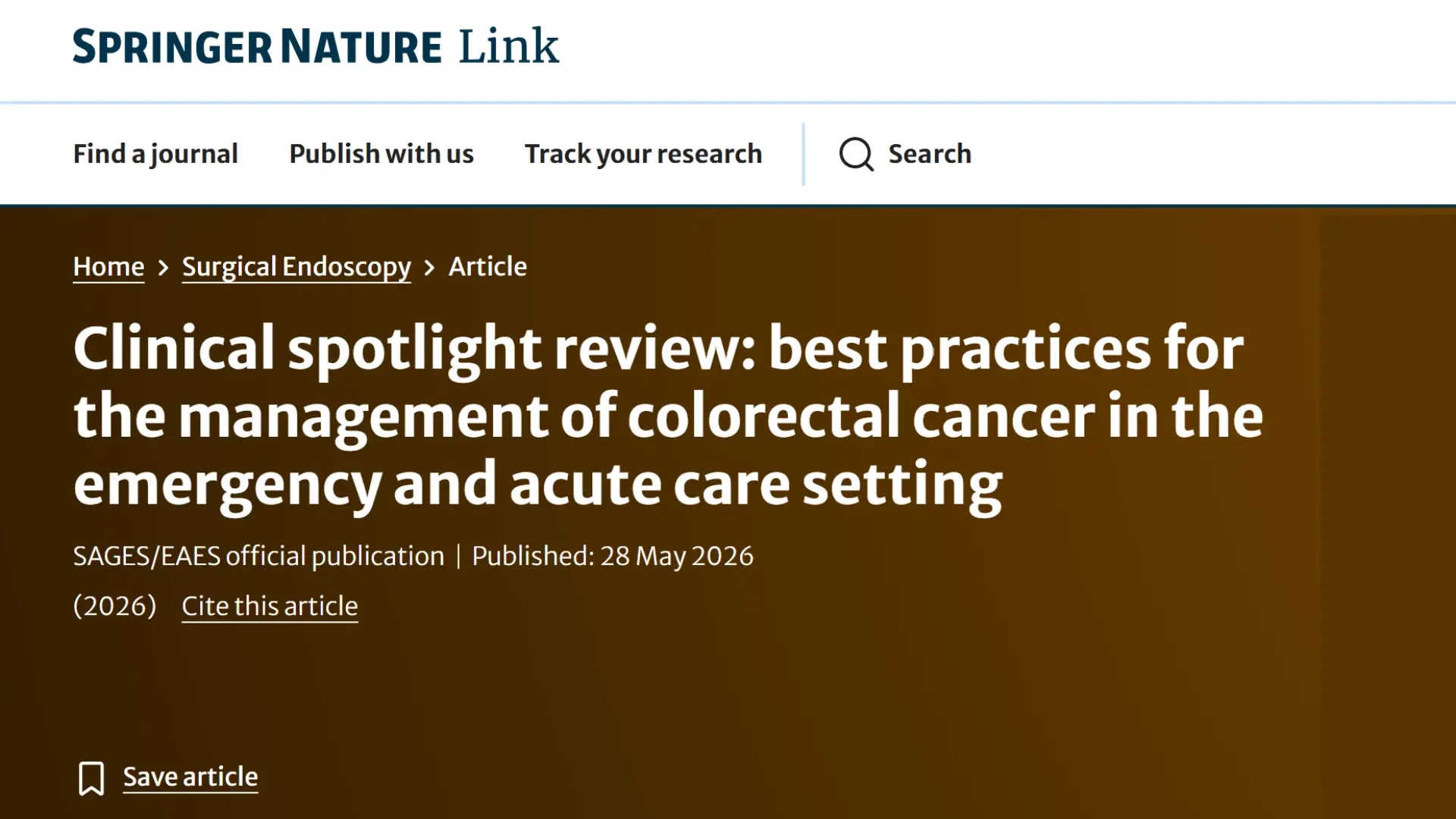
Dr. Patricia Tejedor, colorectal surgeon at Quenet-Torrent Institute, is the first author of the article "Clinical spotlight review: best practices for the management of colorectal cancer in the emergency and acute care setting", published in the scientific journal Surgical Endoscopy.
An international scientific collaboration
The work is part of an initiative of the Society of American Gastrointestinal and Endoscopic Surgeons (SAGES), carried out through its Colorectal Surgery and Emergency Surgery committees.
An international group of surgeons takes part in the project, with the aim of setting out practical recommendations for the management of colorectal cancer that presents as an emergency, especially in cases of bowel obstruction, perforation or bleeding.
Why colorectal cancer in the emergency setting is a clinical challenge
These emergency presentations are a significant clinical challenge. They are usually associated with:
- Tumors at a more advanced stage at the time of diagnosis.
- Greater surgical complexity and the need for emergency surgery.
- A higher risk of postoperative complications.
- Worse oncological outcomes in the medium and long term compared with elective surgery.
For this reason, the article reviews the available scientific evidence and proposes management strategies aimed at improving decision-making in highly complex scenarios.
Main recommendations for surgical management
Among its most relevant conclusions, the work highlights the importance of:
- Making a fast and accurate diagnosis, optimizing the initial assessment with contrast-enhanced CT and, when possible, urgent endoscopy.
- Maintaining the principles of oncological surgery even in the emergency setting: adequate lymphadenectomy, oncological margins, total mesorectal excision when appropriate.
- Individualizing treatment according to tumor location (colon cancer versus rectal cancer) and each patient's clinical situation.
- Considering bridge-to-surgery strategies whenever possible: self-expanding colonic stents in left colon obstruction, diverting stomas or staged resections, to avoid emergency surgery when the patient's clinical situation allows it.
What this means in clinical practice
The SAGES recommendations give surgeons guidance based on the available evidence for a situation that has traditionally been handled case by case, with criteria that vary between hospitals. With shared criteria, a patient whose colorectal cancer first presents in the emergency department should receive similar treatment wherever they are operated on.
Commitment to research and colorectal surgery
At Quenet-Torrent Institute we are sharing this publication, which comes from our participation in international research on the surgical treatment of colorectal cancer.
Dr. Patricia Tejedor leads our institute's colorectal surgery unit, where we apply these recommendations to the treatment of colorectal cancer, both in elective surgery and in cases that need emergency care.
Further reading
- Colon cancer: what it is, symptoms, diagnosis and treatment
- How to prevent colon cancer: screening and risk factors
- How much do we really know about colon cancer?
Read the full article
You can read the full article on the journal's website: Surgical Endoscopy: SAGES Clinical Spotlight Review.