
30+ years of experience
500+ CRS+HIPEC procedures
International multidisciplinary committee
Research

Neoadjuvant chemotherapy in colon cancer: what the ELECLA trial shows

The Spanish ELECLA trial, published in ESMO Open with the participation of Dr. Patricia Tejedor, evaluates giving chemotherapy before surgery in locally advanced colon cancer with a proficient mismatch repair (pMMR) molecular profile.

08/07/2026 · Dr. Patricia Tejedor · ESMO Open

Neoadjuvant chemotherapy in locally advanced colon cancer: the ELECLA trial
Dr. Patricia Tejedor

Article written by

Dr. Patricia Tejedor

Co-author of the study, together with the rest of the ELECLA trial Collaborative Group investigators

Quenet Torrent Institute

View full profile →

The treatment of locally advanced colon cancer is evolving towards increasingly personalized strategies. For years, the usual approach has been to perform surgery first and then decide on the need for chemotherapy based on the pathological analysis of the surgical specimen.

However, in certain patients a different strategy may be considered: giving chemotherapy before surgery. This approach, known as neoadjuvant treatment, allows systemic therapy to start early, act on possible microscopic disease from the outset, and assess the tumor's sensitivity to treatment.

The ELECLA trial

This is the context of the ELECLA trial, a Spanish multicenter study published in ESMO Open, in which Dr. Patricia Tejedor took part. The work evaluates the role of neoadjuvant chemotherapy in patients with locally advanced colon cancer and a proficient mismatch repair (pMMR) molecular profile.

ELECLA is a randomized, phase II trial carried out across 12 hospitals in Spain, comparing two strategies: neoadjuvant chemotherapy (three cycles of CAPOX or five of FOLFOX) followed by surgery and adjuvant chemotherapy, versus the standard approach of upfront surgery followed by adjuvant chemotherapy.

Main results

The main results of the study show that neoadjuvant treatment was:

  • Safe and feasible, with no increase in surgical complications compared with upfront surgery.
  • Associated with a high treatment completion rate (94.2% of patients completed all planned cycles).
  • Able to significantly reduce tumor volume (a mean radiologic reduction of 65.4%).
  • Associated with complete (R0) resection in all patients treated with neoadjuvant chemotherapy.
  • Related to more favorable pathologic features, such as less lymphatic invasion (21.5% versus 44.1%) and less tumor budding (23.3% versus 58.5%).
Downstaging of tumor T and N stage in the neoadjuvant group: before versus after treatment in the ELECLA trial
Downstaging of tumor stage (T and N) in the neoadjuvant group, comparing before and after treatment. Source: ELECLA trial, ESMO Open (2026).

Regarding survival, the 2-year disease-free survival rate was 88.9% in the neoadjuvant group and 83.3% in the upfront surgery group. This figure should be interpreted with caution: it comes from an interim analysis of a trial whose recruitment ended early, so the survival difference did not reach statistical significance and should be considered exploratory.

Not every patient is a candidate

These results support the interest of neoadjuvant treatment as an innovative strategy in locally advanced colon cancer. Nevertheless, not every patient is a candidate for treatment before surgery. The indication must be carefully individualized, taking into account tumor extension, molecular profile, the patient's general condition and surgical risk.

For this reason, the decision must always be made within a multidisciplinary tumor board, with the coordinated participation of colorectal surgery, medical oncology, radiology, pathology and other specialists involved in the process. This joint assessment allows the best therapeutic sequence to be defined for each patient.

Innovation in colon cancer is not only about incorporating new treatments, but about knowing how to select which patient can benefit from each strategy and when it should be applied. In our unit we promote this model of care based on scientific evidence, multidisciplinary work and personalized treatments.

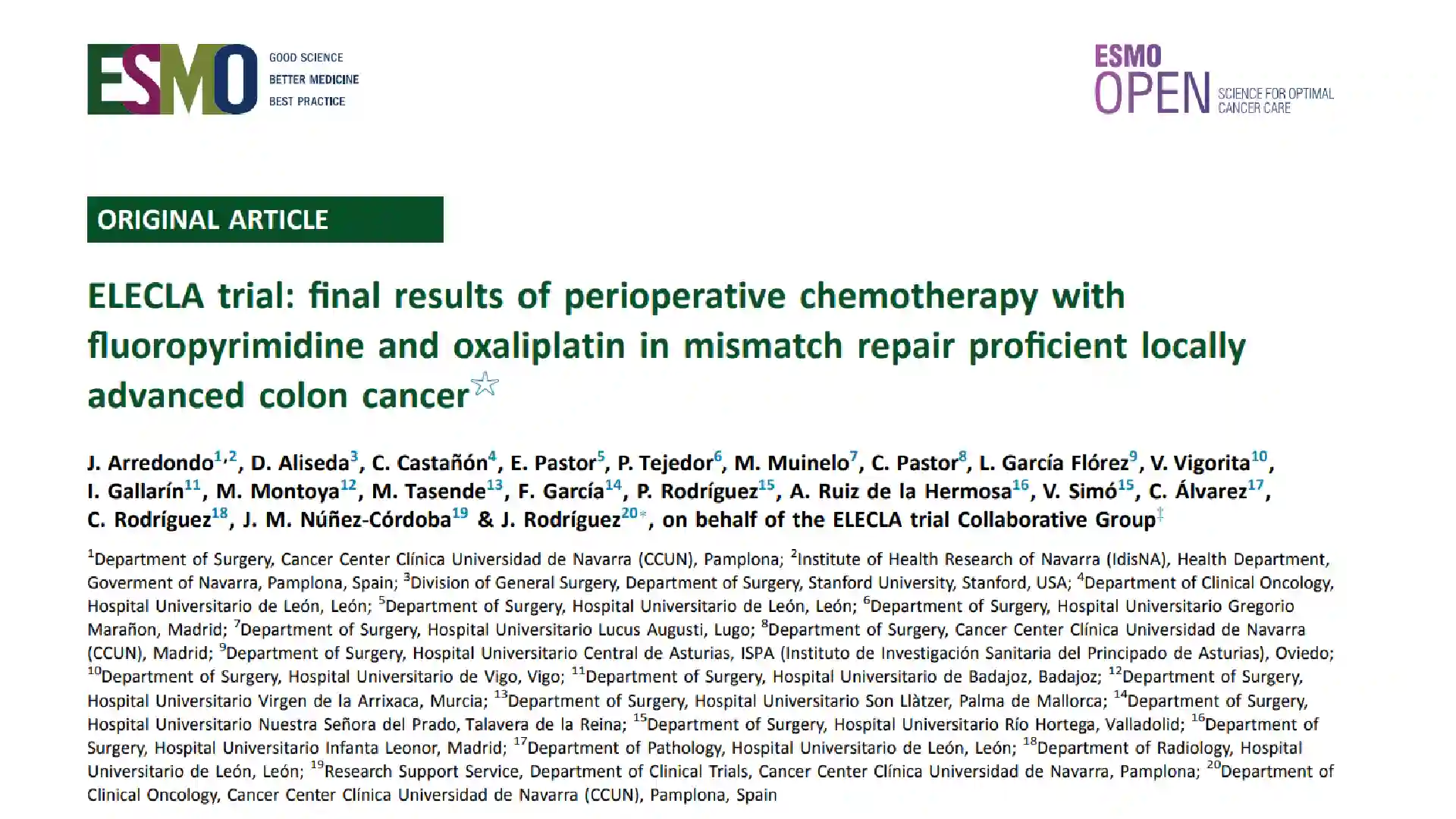
Original article: ELECLA trial: final results of perioperative chemotherapy with fluoropyrimidine and oxaliplatin in mismatch repair proficient locally advanced colon cancer. ESMO Open (2026). Read the full study.

Need to speak with a specialist?

Complete the form and schedule your appointment to speak directly with the surgeon.

Request consultation