
WORLD LEADERS RECOGNIZED SCIENTIFIC LEADERS +20,000 SURGERIES PERFORMED
Research

Cytoreductive surgery for peritoneal metastases in GIST

When to operate, how to select patients and what to expect after tyrosine kinase inhibitor therapy: commentary on the review article published in Clinical and Translational Oncology (2026)

26/04/2026 · Prof. Luis González Bayón · Clinical and Translational Oncology · Springer

Cytoreductive surgery for peritoneal metastases in GIST — Clinical and Translational Oncology study (2026)
Prof. Luis González Bayón

Article written by

Prof. Luis González Bayón

Quenet Torrent Institute

View full profile →

Peritoneal metastases in GIST: the second most common dissemination site

Gastrointestinal stromal tumors (GIST) are the most frequent digestive sarcomas. When they spread, the liver is the first site involved and the peritoneum the second. The review published in Clinical and Translational Oncology in February 2026, with the contribution of Prof. Luis González Bayón, summarises the current role of cytoreductive surgery in these patients, integrating it with tyrosine kinase inhibitor (TKI) therapy.

The clinical message is clear: peritoneal dissemination of GIST has a better prognosis than peritoneal metastases of other sarcomas or epithelial tumors. Well-indicated, well-timed surgery genuinely changes the survival curve.

First line: the TKI guides the decision

The systemic treatment of GIST has been transformed since the introduction of imatinib and subsequent tyrosine kinase inhibitors. The review reaffirms the central principle in 2026: first-line treatment must always be a TKI selected according to the molecular profile of the tumor (KIT, PDGFRA, NF1, SDH and other mutations). Surgery does not compete with targeted therapy — it complements it.

In patients who respond to the TKI, cytoreductive surgery is considered with one specific goal: complete macroscopic resection of residual peritoneal disease, while continuing TKI before and after the operation. In those who progress despite the TKI, surgery offers limited benefit and is reserved for exceptional situations such as salvage surgery or complications (obstruction, bleeding, perforation).

The 6-12 month window

One of the most practical takeaways of the review is the optimal timing for surgery: between 6 and 12 months after starting the TKI. This window allows clinicians to:

  • Confirm the response and read the real biology of the tumor.
  • Identify the responders who genuinely benefit from surgery.
  • Avoid operating on early progressors, where the morbidity of major surgery outweighs any oncologic benefit.
  • Reduce the tumor burden to enable complete resections with lower risk.

Operating before 6 months does not allow proper assessment of tumor biology; waiting beyond 12 months increases the risk of TKI-resistant clones emerging.

What survival can we expect?

The review compiles the main international registries and retrospective series. In carefully selected patients, cytoreductive surgery combined with TKI achieves:

  • 5-year overall survival rates of up to 80%.
  • 5-year disease-free survival rates of 30-35%.

These figures are markedly better than those reported in non-GIST peritoneal carcinomatoses and reflect both the favourable biology of these tumors when they respond to TKI and the importance of complete resection as the surgical goal.

"Surgery should aim for complete macroscopic resection, integrate within the TKI trajectory, and be discussed in a multidisciplinary committee. Patient selection is what separates a good outcome from a poorly indicated one."

— Commentary on the review, Clinical and Translational Oncology · 2026

Centre and team: variables as critical as the surgery

The review makes a point that can hardly be overstated in peritoneal oncology: decisions must be made in multidisciplinary teams at experienced centres. The complexity of a GIST with peritoneal metastases — multiple resections, risk of visceral involvement, perioperative TKI integration — demands:

  • An oncological surgeon experienced in sarcomas and peritoneal disease.
  • A medical oncologist familiar with TKI in GIST and its molecular profile.
  • A pathologist with expertise in digestive sarcomas and molecular biology.
  • Anaesthesia and post-surgical units prepared for major prolonged abdominal surgery.
  • Imaging and nuclear medicine support capable of evaluating response beyond RECIST criteria.

This is precisely the model we apply at the Quenet Torrent Institute, in joint clinical coordination with the Peritoneum, Retroperitoneum and Complex Pelvis Unit at Hospital General Universitario Gregorio Marañón, where Prof. González Bayón serves as head of unit.

What this means for our patients

When a patient with GIST and peritoneal dissemination requests a second opinion, the algorithm we follow is consistent with the review's recommendations:

  1. Confirm the molecular profile of the tumor (KIT, PDGFRA, etc.) and start a targeted TKI if not already in place.
  2. Reassess at 6-12 months with CT and/or PET-CT, evaluating both morphologic and metabolic response.
  3. Consider complete cytoreductive surgery in responders with resectable disease, integrating techniques such as open surgery and, where pelvic involvement exists, pelvic exenteration; and continue TKI postoperatively.
  4. Reserve surgery in progressors for complications, controllable local oligoprogression or symptomatic palliation.

About the article and the authors

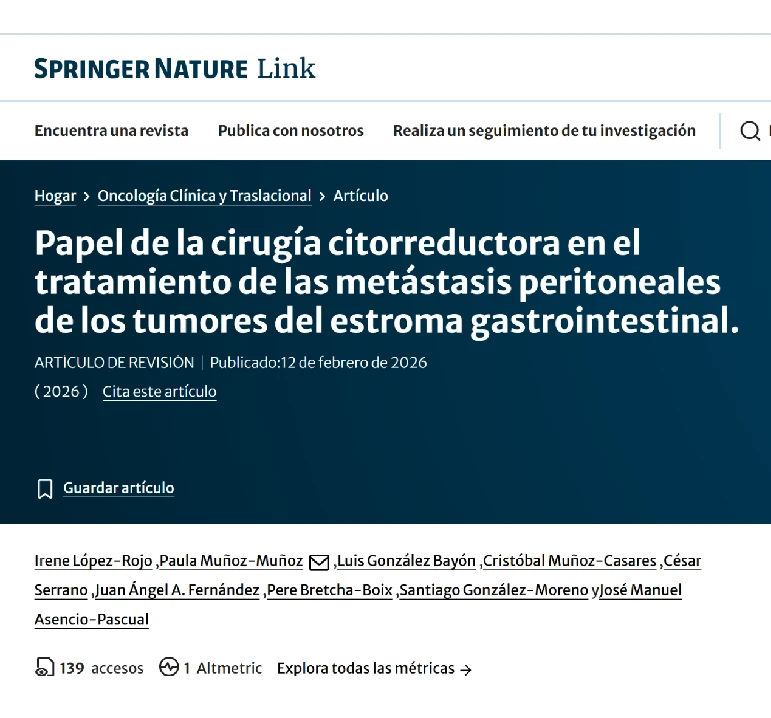
The article — Role of cytoreductive surgery in the management of peritoneal metastases for gastrointestinal stromal tumors — is a narrative review published in Clinical and Translational Oncology on 12 February 2026. It brings together leading Spanish authorities in sarcoma and peritoneal oncology: Irene López-Rojo, Paula Muñoz-Muñoz, Luis González Bayón, Cristóbal Muñoz-Casares, César Serrano, Juan Ángel A. Fernández, Pere Bretcha-Boix, Santiago González-Moreno and José Manuel Asencio-Pascual.

Prof. Luis González Bayón, member of our team and head of the Peritoneum, Retroperitoneum and Complex Pelvis Unit at Hospital Gregorio Marañón, contributes to this review more than 40 years of experience in peritoneal oncological surgery, sarcomas and carcinomatosis. This publication adds to his ongoing work on abdominal and retroperitoneal sarcomas and malignant peritoneal disease.

View Prof. González Bayón's profile

Need to speak with a specialist?

Complete the form and schedule your appointment to speak directly with the surgeon.

Request consultation